FALL CAMPAIGN FOR STRONGER MAiD PROTECTIONSNo one should feel pushed toward MAiD.
No one should be offered Medical Assistance in Dying (MAiD) unless they request it.
No healthcare professionals should be required to participate in MAiD against their convictions.
Help protect patients and providers this fall in Saskatchewan.

THIS FALL ACROSS SASKATCHEWAN,
we’re gathering stories, building support and inviting action.
Hope Does Not Expire is bringing together patients, families, healthcare professionals, faith communities and Saskatchewan residents around stronger MAiD protections.
OUR GOALS THIS FALL

2500
Public petition signatures

300
Healthcare professional signatures

Stories
From across Saskatchewan

Present the case
Bringing Saskatchewan stories and signatures to MLAs
WHAT WE’RE HEARING ABOUT
These experiences matter
Without your stories, many of these experiences stay hidden. Your story will be kept confidential.
LONG-TERM CARE
No one in care should be made to feel like a burden.
One Saskatchewan family reports that MAiD was raised with their loved one in long-term care without family present. The family only learned about the conversation afterward, including that the resident had been asked:
“Wouldn’t you rather stop being a burden?”
STUDENTS & TRAINING
No student should have to choose between conscience & their career.
Students in medicine, nursing and pharmacy have told us they can feel vulnerable when MAiD participation expectations are unclear.
Healthcare professionals and students can sign the statement of support confidentially.
PATIENT CARE
Repeated offers feels like pressure not care.
A Canadian priest reports that MAiD was offered to him more than once, after he had already declined. If it is happening in another province, it might be happening in Saskatchewan.
Has this happened to you or someone you love?
Your experience matters.
Tell us what happened →
MAiD is legal across Canada. Federal law sets eligibility.
But Saskatchewan still decides how healthcare is delivered within the province.
We are asking the Government of Saskatchewan to put two clear protections into law.
As MAiD expands, protections
matter even more.
Saskatchewan can act now.
Two protections. One simple principle: no one should be pressured.
Two protections. One simple principle: no one should be pressured.
1.
How MAiD is raised with patients
The campaign proposes that MAiD be discussed when a patient raises it or identifies it as part of their goals of care, rather than being introduced unsolicited.
How healthcare professionals participate
2.
The campaign is also seeking protections for healthcare professionals who decline participation in MAiD because of moral or ethical convictions.
SASKATCHEWAN RESIDENTS
SIGN THE PETITION
The public petition asks the Government of Saskatchewan to act on the campaign’s two proposed protections.
Because it is a Legislative Assembly petition, signatures must be collected on paper. Saskatchewan rules require original signatures and addresses written directly on the petition, so there is no online petition.
Can’t find a location near you? Print off the petition sheet and mail it in with your signature. Every one counts! MAIL PHYSICAL PETITIONS BY November 23, 2026 to Archdiocese of Regina, 200–2151 Scarth Street, Regina, SK S4P 2H8
Our fall goal is 2,500 signatures
WHERE TO SIGN
✓ Archdiocese of Regina: 200–2151 Scarth Street, Regina, SK S4P 2H8
Add your name to a letter to the government of Saskatchewan asking them to enact legislation to provide protections for vulnerable patients and health care professionals who decline to participate in MAiD.
Participation in MAiD should be voluntary.
HEALTHCARE PROFESSIONALS & STUDENTS
Our fall goal is 300 signatures
✓Names can be kept confidential and will not be published.
✓ Signing is online and takes a few minutes.
✓ Students, residents and trainees are welcome to sign.
✓ Names are due by November 23.
Your experience matters.
You may have experienced something yourself. You may have watched it happen to someone you love. You may work or train within healthcare.
FREE ONLINE WEBINAR
Hope at the End of Life
MAiD, palliative care and hope in the hard moments.
Join healthcare professionals and other speakers for an evening exploring MAiD, palliative care and experiences within the healthcare system.November X, 2026 · 7 p.m. · Online
November X, 2026 · 7 p.m. · Online
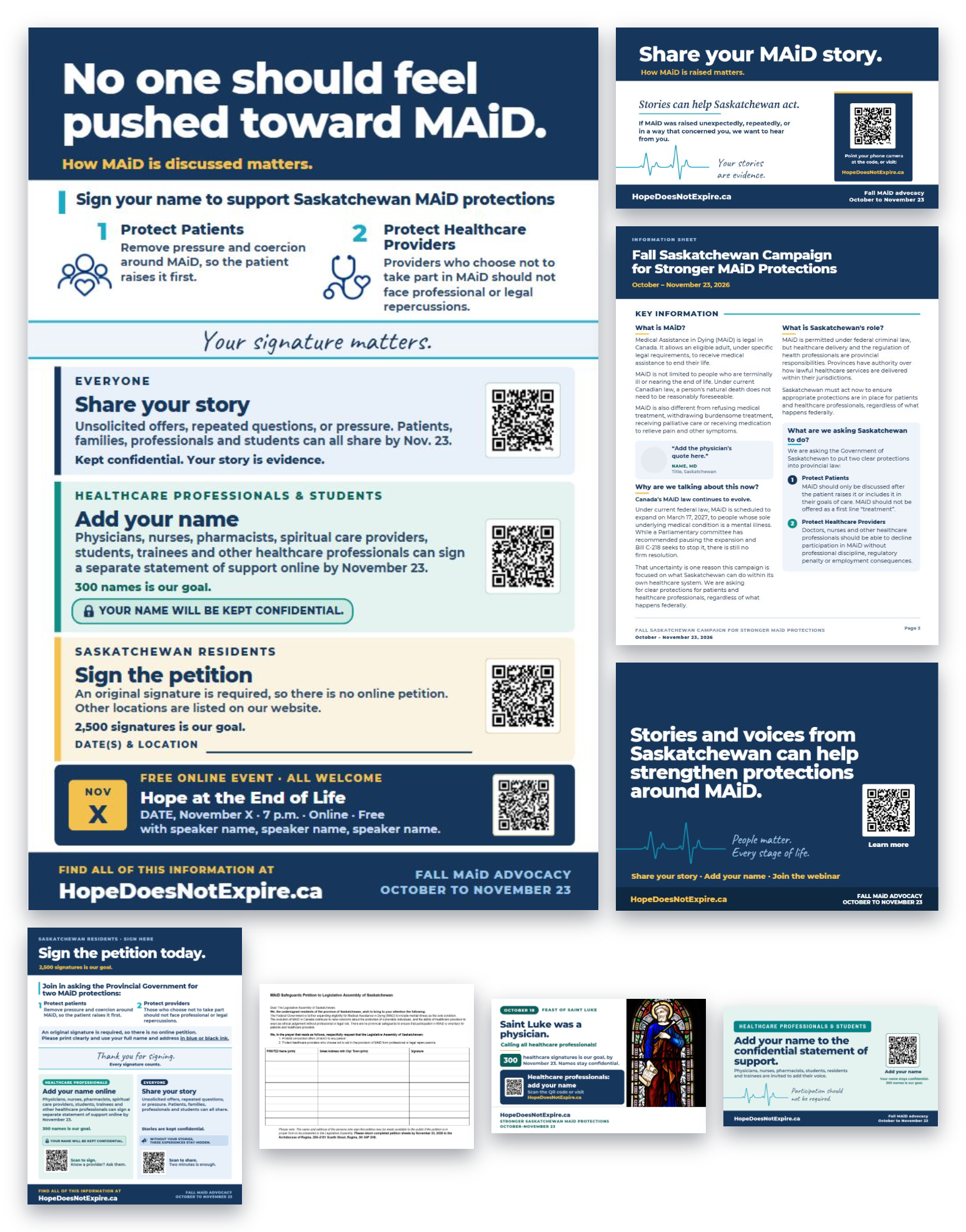
Partner with us to raise awareness, share trusted information and connect people with opportunities to take part.
Churches, community organizations, healthcare networks and local leaders can use the Hope Does Not Expire Community Toolkit to share campaign information in the ways that work best for their community.
MAIL PHYSICAL PETITIONS BY November 23, 2026 to Archdiocese of Regina, 200–2151 Scarth Street, Regina, SK S4P 2H8
Help us reach more Saskatchewan communities.
COMMUNITY TOOLKIT
WHAT’S INSIDE
✓ Petition sheet & information package
✓ Posters and social graphics
✓ Bulletin and newsletter copy
✓ PowerPoint slides
✓ Announcements and handouts
✓ Webinar promotional materials
✓ Guidance for sharing the campaign
Who is behind
this campaign?
ABOUT
Hope Does Not Expire is a Saskatchewan-based committee of physicians, healthcare professionals, lawyers, advocacy leaders and community partners working together to strengthen protections for patients and providers as MAiD eligibility expands.
Connect with Us
Have a question about the campaign, want to get involved, or looking for more information?
We’d love to hear from you.
What You Might Be Wondering
-
MAiD is legal under federal law, but Saskatchewan still has responsibility for how healthcare is delivered and regulated within the province.
-
No. We are asking Saskatchewan to put clear protections in place for patients and healthcare professionals.
-
Patients should be the ones to raise MAiD, and healthcare professionals should be able to decline participation without penalty.
-
Policies can change. Legislation creates clearer, more durable protections that patients and healthcare professionals can rely on.
-
MAiD eligibility is expected to expand in 2027 to include some people whose sole underlying condition is mental illness. As eligibility expands, safeguards matter more.